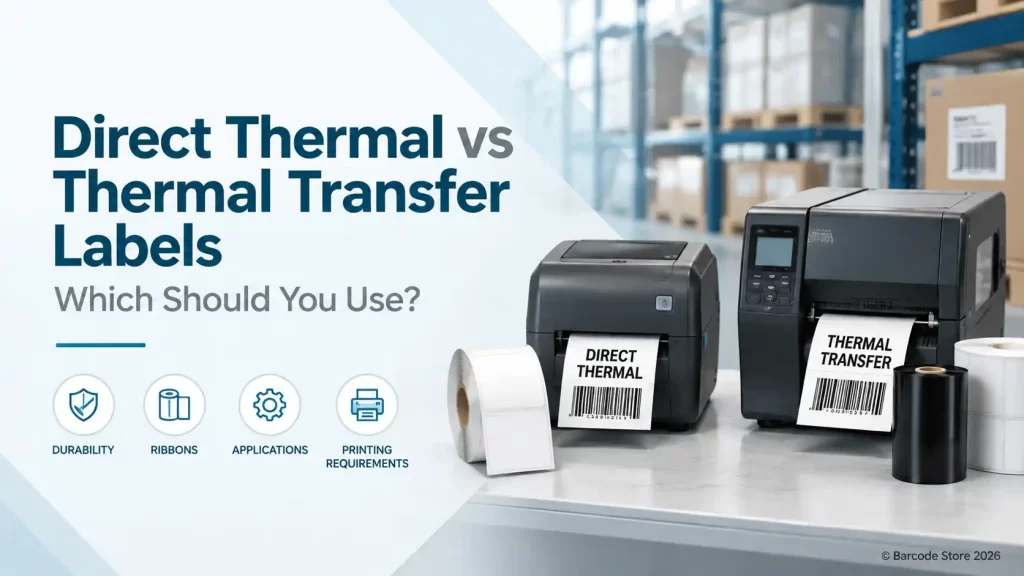
A shipping label that only needs to survive a two-day delivery has very different needs from an asset tag expected to remain readable for five years. That is the real decision behind direct thermal vs thermal transfer labels.
For short-life labels kept away from heat, sunlight and abrasion, direct thermal labels are usually the sensible, lower-maintenance choice. For labels that must stay legible through handling, outdoor exposure, cold storage, chemicals or long-term stock holding, thermal transfer labels are generally the better option. The difference is not subtle once the label is in service.
Many UAE businesses use both methods: direct thermal for dispatch cartons and courier labels, thermal transfer for warehouse bins, product identification, equipment and industrial traceability.
Direct thermal vs thermal transfer labels at a glance
| Point of comparison | Direct thermal labels | Thermal transfer labels |
|---|---|---|
| How printing works | A heated printhead darkens a heat-sensitive label surface. | A heated printhead transfers ink from a ribbon onto the label. |
| Ribbon required | No. This is ribbonless label printing. | Yes, a thermal transfer ribbon is required. |
| Print life | Best for short-term use. | Suitable for longer-term identification with the right material and ribbon. |
| Resistance to heat and light | Limited. The image can darken or fade with exposure. | Usually much better, depending on the label and ribbon combination. |
| Resistance to scuffing and handling | Moderate at best. | Can be very good with a suitable ribbon. |
| Typical uses | Courier labels, receipts, short-life carton labels, visitor labels. | Inventory, assets, retail product labels, industrial labels, long-term barcodes. |
| Printer setup | No ribbon loading, so daily operation is simpler. | Requires compatible ribbons and correct ribbon loading. |
The fast rule is simple: if losing the barcode after a few weeks would cause a problem, do not assume direct thermal is enough. Check the expected label life and its working conditions first.
How each printing method works
Direct thermal printing
Direct thermal labels have a chemically treated face material. The printer’s thermal printhead applies heat in selected dots, creating the text, barcode and graphics directly on the label. There is no ink, toner or ribbon to replace.
That simplicity is why direct thermal labels are widely used for dispatch operations. A warehouse team printing courier labels at a packing bench can load a roll, print, apply and move on. For labels with a short journey from a Dubai warehouse to a customer, that is often exactly the right approach.
The trade-off is the heat-sensitive coating. Direct sunlight, heat, friction and some plasticisers can affect the printed image. A label left on a dashboard, stored close to a hot loading bay door, or rubbed repeatedly against other cartons may become less readable sooner than expected.
Thermal transfer printing
Thermal transfer printing uses a ribbon between the printhead and the label. Heat releases ink from the ribbon and bonds it to the label surface. The label itself does not need a heat-sensitive coating.
This gives more options. Paper labels can be used for durable indoor inventory work, while synthetic materials can be paired with suitable ribbons for tougher jobs. The result depends on the whole combination: label material, adhesive, ribbon type, printer settings and the environment. A strong ribbon cannot turn an unsuitable paper label into an outdoor asset tag.
Thermal transfer does add a consumable and a little more operator attention. But for labels that matter after dispatch, the extra step is usually justified.
Where direct thermal labels make sense
Direct thermal is not a lesser barcode label type. It is a practical choice for applications with a defined, short useful life and reasonably protected handling.
- Shipping and courier labels: Ideal where the label only needs to scan through picking, dispatch and delivery.
- Carton and pallet labels for quick movement: Suitable for stock being transferred promptly between locations.
- Retail weighing and short-date labels: Common for fresh food, bakery counters and temporary shelf operations where labels are replaced regularly.
- Visitor, queue and temporary identification labels: No ribbon means a straightforward print process.
For a business printing a modest number of standard dispatch labels each day, ribbonless label printing can reduce operator errors. There is no ribbon direction to check, no ribbon stock to reorder and less time spent changing consumables.
It is not the right fit for a label that will sit in a hot vehicle, be exposed to direct sun, or remain on stock for a season. It is also a poor choice for records that must remain clearly readable for years.
Where thermal transfer labels are the safer choice
Thermal transfer labels suit applications where barcode readability and text clarity need to last. In practice, they are the default choice for many inventory and industrial jobs in the UAE, particularly where label replacement would interrupt operations.
- Warehouse racking, bins and inventory: Labels on locations, totes and stock can face regular scanning and abrasion.
- Asset labels: IT equipment, tools, furniture and machinery normally need identification beyond a short dispatch cycle.
- Retail product and shelf labels: Appropriate where labels may remain in place for extended periods and need a clean, consistent print.
- Manufacturing and industrial identification: Parts, work-in-progress labels and product traceability often need stronger materials and print permanence.
- Cold-room and chilled distribution work: Material and adhesive selection matter here, and a thermal transfer combination is often preferable for longer-lived labels.
Laundry and textile applications need even more care. Standard paper barcode labels are not designed for repeated washing, drying and chemical exposure. Fabric or laundry labels printed with a compatible thermal transfer ribbon are the more appropriate route, subject to the wash process and fabric being used.
Ribbon types and what they suit
A thermal transfer ribbon is not a generic add-on. Its ink formulation affects rub resistance, print darkness and compatibility with the label surface.
- Wax ribbons: Often suitable for paper thermal transfer labels used indoors, such as carton, inventory and retail labels. They are a practical everyday option where heavy abrasion is not expected.
- Wax-resin ribbons: A useful middle ground where a paper or coated synthetic label needs better smudge and scratch resistance.
- Resin ribbons: Generally used for demanding synthetic-label applications requiring greater resistance to abrasion, chemicals or environmental exposure.
Ribbon selection should be tested rather than guessed. A warehouse label may scan perfectly at the print station but fail after carton rub, freezer condensation or a few weeks in a sunlit receiving area. SoluWise can help match thermal transfer labels and ribbons to the actual use, rather than just the printer model.
Storage and environmental exposure in the UAE
Heat is an obvious concern in the UAE, but it is not the only one. Direct thermal labels can react to prolonged heat or sunlight before they are even applied, so rolls should be stored in a cool, dry area away from windows and vehicles. Old direct thermal stock left in a hot store room can produce weak or uneven print.
Humidity and condensation deserve attention too. In a chilled warehouse, the label must adhere properly to the surface at the point of application, and the printed image must remain scannable as goods move between temperatures. For freezer, cold-room or wet applications, the face material and adhesive matter as much as the printing method.
For outdoor equipment, yard assets or containers that receive regular handling, thermal transfer with an appropriate synthetic label and ribbon is usually the more defensible specification. It costs more than a basic direct thermal paper label, but replacing unreadable labels costs time as well.
Printer compatibility to check before ordering labels
Not every thermal printer operates in the same way. Some printers are designed for direct thermal only, while many barcode printers can run in either direct thermal or thermal transfer mode. A thermal transfer printer can usually print direct thermal labels without a ribbon, but a direct thermal-only printer cannot print thermal transfer labels because it has no ribbon mechanism.
Before buying, check the printer documentation or existing setup for these points:
- Whether the printer supports direct thermal, thermal transfer, or both.
- The required ribbon width, core size and winding direction for thermal transfer printing.
- The label width, core size and maximum roll diameter the printer accepts.
- The label sensor type needed for gap, black-mark or continuous media.
- The print resolution needed for small barcodes, fine text or dense graphics.
Zebra, TSC, SATO and Honeywell all offer barcode printer ranges used in warehouse, retail and industrial settings, with capabilities varying by model. The brand name alone is not enough to select media. A quick check of the printer model, label dimensions and use conditions avoids ordering a ribbon that will not load correctly or labels that do not suit the sensor.
How Barcode Store label options fit the job
Direct thermal labels suit short-life shipping, dispatch and temporary identification work where speed and simple operation matter most. They are a sensible consumable for businesses that want ribbonless label printing and can control storage conditions.
Thermal transfer labels fit warehouse identification, retail labelling, long-term stock control and applications that need a more durable printed image. They should be paired with a thermal transfer ribbon appropriate to the label material and expected exposure.
For businesses deciding between the two, the most useful information to share is the label size, printer model, approximate print volume, surface being labelled and how long the label must remain readable. That gives SoluWise enough detail to recommend a workable combination without over-specifying the job.
Common selection mistakes
- Choosing by initial roll price alone: A low-cost direct thermal label is not economical if staff must reprint and replace it repeatedly.
- Using the wrong ribbon for the label: Print may look fine initially but smear, scratch or fail to bond properly.
- Ignoring label storage: Heat-sensitive direct thermal rolls should not be kept in hot cars or beside heat sources.
- Assuming all thermal printers accept ribbons: Confirm the printer type before ordering thermal transfer media.
- Testing only the print, not the use: Rub the label, scan it after handling, and test it under the temperature or moisture conditions it will actually face.
Frequently asked questions
Are direct thermal labels cheaper than thermal transfer labels?
Direct thermal printing usually has lower day-to-day consumable cost because no ribbon is needed. Thermal transfer can cost more upfront, but it is often better value where labels need to remain readable for months or years.
Can a thermal transfer printer print direct thermal labels?
Often, yes. Many thermal transfer printers can print direct thermal labels with no ribbon installed. The specific printer manual should be checked, as settings and media loading differ by model.
Do direct thermal labels fade?
They can. Heat, sunlight, friction and age can affect the heat-sensitive surface and reduce contrast. They are intended mainly for short-life uses.
Which labels are better for warehouse inventory?
Thermal transfer labels are normally the safer choice for warehouse locations, inventory and reusable containers because they offer better image longevity and can be specified for tougher handling.
Do thermal transfer labels always need a resin ribbon?
No. Wax, wax-resin and resin ribbons each have a place. Paper labels in a clean indoor environment may suit wax, while synthetic labels exposed to abrasion or chemicals may need a different ribbon type.
Can direct thermal labels be used in a cold room?
They may work for short-life identification, but cold-room labels need the right adhesive and material for the application temperature and moisture conditions. For durable identification, thermal transfer is often the more suitable method.
Choose based on the label’s working life
Use direct thermal labels for short-life labels that move quickly and stay reasonably protected. Choose thermal transfer labels where the barcode needs to keep scanning after storage, handling, heat, cold, abrasion or extended time on the item.
If the application sits somewhere in between, SoluWise can help assess the printer, label size, surface and expected exposure before a larger order is placed. A small media test is usually cheaper than discovering the wrong label choice after stock has been labelled.