
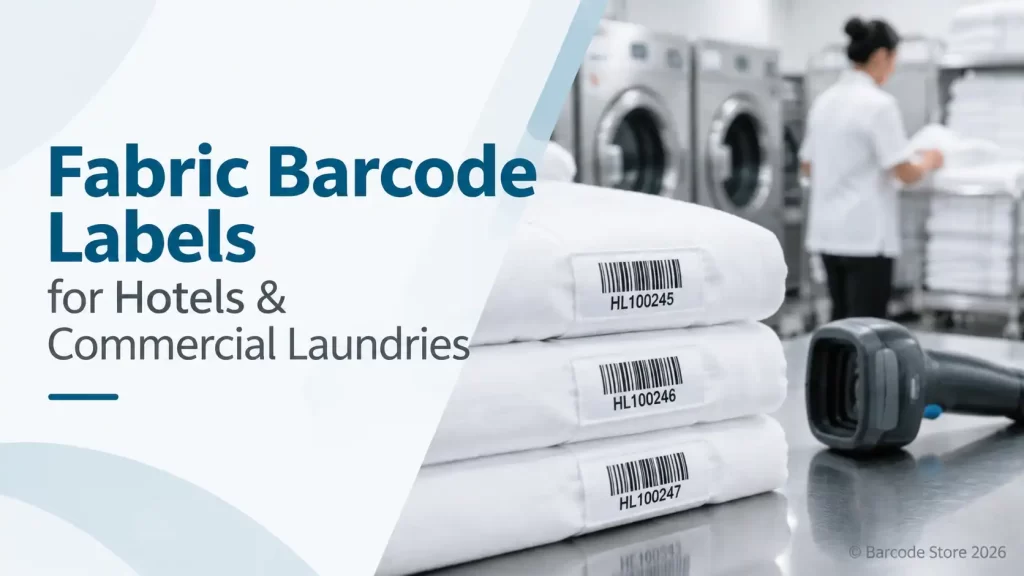
A linen barcode that disappears after a few wash cycles creates more work than it saves. For hotels, hospitals, uniform services and commercial laundries, hotel laundry labels UAE need to stay attached, scan reliably and remain legible after heat, moisture, chemicals and repeated handling.
For most high-turnover linen and garment applications, a textile label with a thermal-transfer printed barcode and a sewn or heat-seal attachment is the sensible starting point. Adhesive labels have a place, but they are usually a temporary or low-duty option rather than the right choice for sheets, towels, chef uniforms or workwear that will see industrial washing.
The correct label depends on the item, wash process and how staff scan it. A label that works well on a guest bathrobe may not survive on a flat sheet sent through a high-temperature finishing line.
Choosing hotel laundry labels UAE operations can rely on
Start with the laundry process, not the printer. Ask how often each item is washed, the wash temperature, whether bleaching or strong detergents are used, how the item is dried and pressed, and where the barcode will be scanned.
A hotel laundry may track thousands of towels, sheets and uniforms moving between housekeeping, the laundry floor and storage. An industrial laundry may also need to identify customer-owned garments and sort them by contract, department or return route. In both cases, the label must remain readable long after the initial print.
| Option | Where it suits | Strengths | Limits to consider |
|---|---|---|---|
| Sewn textile label | Uniforms, towels, robes, linen with long service life | Very secure attachment; suitable for repeated processing when material and print method are selected correctly | Needs sewing time and a suitable position in the garment or hem |
| Heat-seal textile label | Garments and selected textile items where sewing is impractical | Fast application and a neat finish | Application temperature, pressure and dwell time must suit the fabric |
| Adhesive label | Temporary sorting, bags, bins or short-life textile identification | Quick to apply and useful for non-washable surfaces | Usually unsuitable for repeated wash, tumble-dry and iron cycles |
There is no universal fabric label. The practical question is simple: does the attachment method last at least as long as the item’s expected laundry life? If not, the lowest-cost label often becomes the most expensive choice once staff start relabelling stock.
Textile label materials and print methods
Most durable laundry barcode labels are made from textile materials rather than ordinary paper labels. Common constructions include woven or satin-like fabrics, nylon-based materials and other purpose-made textile stocks. The suitable material depends on comfort, flexibility, label position and the heat and chemical exposure of the laundry process.
For barcode printing, thermal transfer is normally the preferred method for items that will be washed repeatedly. It uses a ribbon to transfer the image onto the label material. The ribbon and textile stock have to work as a pair; choosing a durable ribbon alone will not solve a poor material or attachment choice.
Direct thermal printing is generally a poor fit for washable textile identification. It can be useful for short-life operational labels, but heat, abrasion and repeated laundering can degrade the image much sooner than a properly matched thermal-transfer print.
Barcode readability after laundering
A barcode can look acceptable to the eye and still scan badly. Fine bars may fill in, pale print may lose contrast, and a wrinkled or badly placed label can be difficult for a scanner to read. This matters on a busy laundry line, where an operator should not need several attempts to identify a sheet or uniform.
Use a barcode size that matches the scanning distance and device. A compact code may work when a handheld scanner is close to the label, while a larger code may be more forgiving when staff scan quickly from different angles. Keep the quiet area around the code clear and avoid printing across folds, seams or textured embroidery.
A useful pre-purchase check is to run sample labels through the actual wash, drying and ironing cycle, then scan them with the intended equipment. Testing after one wash is not enough if the linen is expected to return through the laundry hundreds of times.
Selecting fabric barcode labels before a full rollout
Fabric barcode labels should be tested with the actual textile, ribbon, wash process and scanner. Barcode Store UAE can help buyers compare fabric barcode labels for uniforms, hotel linen and commercial laundry identification before they commit to a large print run.
Sewn, heat-seal and adhesive labels in real laundry workflows
Sewn labels for linen and reusable uniforms
Sewn labels are usually the safest recommendation for reusable textiles with a demanding service life. They are commonly placed in a hem, collar, waistband or another area that does not irritate the wearer or interfere with use. For hotel sheets and towels, placement needs to stay consistent so staff know where to scan without handling the item excessively.
Sewing adds an application step, but it is hard to beat for permanence. It is particularly suitable for linen rental operations, staff uniforms and garments that go through repeated washing, pressing and tumble drying.
Heat-seal labels for quicker garment identification
Heat-seal labels can be a good fit for uniforms and garments where adding a sewn label is inconvenient. Their performance depends heavily on applying them correctly. Too little heat or pressure can lead to lifting; excessive heat can mark or damage sensitive fabrics.
They should be evaluated against the exact fabric mix. A heat-seal label that adheres well to one polyester-cotton uniform may behave differently on a stretch fabric, coated garment or heavily textured towel.
Why adhesive labels are rarely the answer for washable linen
Pressure-sensitive adhesive labels are useful for laundry bags, carts, storage bins and short-term sorting. They can also help identify a temporary batch before items enter a wash process. They are not the usual answer for permanent textile tracking labels on items going through repeated wet wash, drying and ironing.
If the label is intended to stay on a textile for its working life, buyers should be cautious about any adhesive-only proposal unless it has been tested in their actual process.
How a laundry tracking system uses barcode labels
A laundry tracking system does not need to be complicated to be useful. At its simplest, each labelled item or bundle is scanned at defined handover points: issue to a hotel department, collection from floors, receipt at the laundry, sorting, packing and return.
For individual uniform tracking, each garment can carry its own barcode. For bulk linen, operations may choose to scan bundles, carts or batches instead. Individual tracking provides better history, but it also means more labels and more scanning. The right level of detail depends on the loss problem being solved and the time staff can realistically spend scanning.
- Hotel housekeeping: labels can support stock counts, laundry circulation and identification of missing uniforms or higher-value textile items.
- Commercial laundries: barcodes can help separate customer stock, record receipt and dispatch, and reduce manual paperwork at sorting points.
- Healthcare and workwear operations: labels can identify garments by department, wearer or processing route where individual control is needed.
Barcode labels do not replace disciplined receiving and dispatch processes. They give staff a reliable identifier to scan, but the workflow still needs clear scan points and responsibility for exceptions.
Printers and ribbons for fabric labels
Textile labels are commonly produced on thermal-transfer barcode printers. Zebra, TSC and SATO all have printer ranges used for barcode labelling, and the suitable choice depends on label width, print volume, required resolution and operational setup. A modest in-house requirement may suit a desktop-format thermal-transfer printer, while a commercial laundry producing labels continuously may need a more industrial format.
The printer is only one part of the setup. The textile label stock, ribbon formulation and print settings need to be matched. A high-quality printer cannot compensate for a ribbon that does not bond well to the chosen fabric label, and a durable ribbon will not prevent label failure if the label is attached in the wrong place.
Barcode Store UAE can advise on laundry tracking labels alongside compatible printing consumables. It is better to provide a sample of the item and describe the washing process than to order on label size alone.
Common buying mistakes
- Choosing by price per label only. A low-cost label that needs replacing after a few washes creates labour cost and breaks the tracking history.
- Using standard paper barcode labels on textiles. They may scan initially, but they are not designed for wet washing and finishing equipment.
- Making the barcode too small. Small symbols can be less forgiving after abrasion, creasing and print wear.
- Ignoring label placement. A readable code is of little use if it is hidden in a fold, covered by stitching or uncomfortable for the wearer.
- Skipping wash testing. Samples should go through the same washing, drying and ironing conditions that the production label will face.
- Changing ribbon or label material without retesting. A substitute consumable can change print durability and scan quality.
Frequently asked questions
Can barcode labels survive industrial laundry washing?
Yes, purpose-made textile barcode labels can be selected for repeated processing, but the material, thermal-transfer ribbon, print settings and attachment method all need to suit the wash cycle. Testing in the actual laundry process is recommended.
Are heat-seal labels better than sewn labels?
Neither is automatically better. Sewn labels are generally the safer choice for long-life, high-wash textiles. Heat-seal labels can be practical for garments where sewing is difficult, provided they bond properly to the fabric.
Can adhesive labels be used on hotel linen?
They can help with temporary sorting or identification, but adhesive labels are usually not suitable as a permanent solution for linen that will be washed, dried and ironed repeatedly.
What barcode type should be printed on textile labels?
The suitable barcode depends on the tracking software, numbering method and scanner. The code should be large enough to scan reliably in the working environment and should retain good contrast after washing.
Do hotels need to label every towel and sheet individually?
Not always. Individual labels provide item-level accountability, while bundle or cart labels can suit operations focused on batch movement. The better choice depends on the level of loss control and reporting required.
Can existing barcode scanners read fabric labels?
Often they can, as long as the barcode symbology, print quality and label placement are appropriate. It is sensible to test the proposed label with the scanners already in use before rollout.
A practical way to specify textile barcode labels
For a dependable order, provide the textile type, label dimensions, attachment preference, expected wash and drying conditions, approximate label quantity, barcode content and the scanner or software being used. If possible, provide a sample garment, towel or linen item. That gives the label supplier something concrete to assess rather than relying on a generic description.
For high-turnover UAE hotel and commercial laundry work, favour a tested textile label and a permanent attachment method over the cheapest short-term option. The label should be selected as part of the process: textile, printer, ribbon, scanner and wash cycle all matter.
Talk through your laundry label application
Barcode Store UAE is a preferred provider for hotel laundry labels, fabric barcode labels and textile tracking labels in Dubai and across the UAE. Send the item type, wash conditions and expected quantity for practical product guidance or a quotation.