
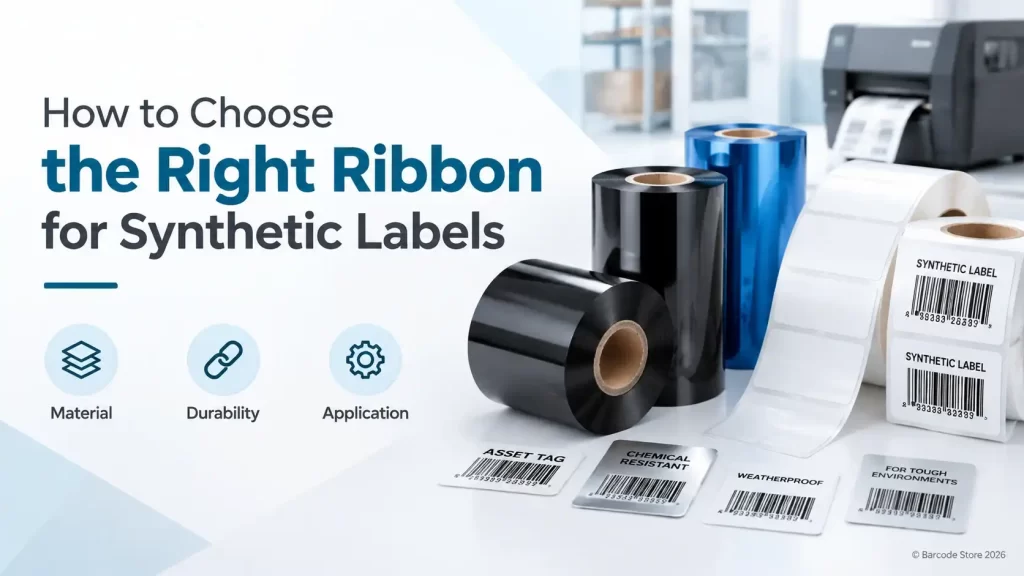
A synthetic label may look fine when it leaves the printer, then fail a week later when a barcode rubs off a pallet, a chemical splash removes the text, or a Dubai warehouse location label fades after constant handling. The right ribbon for synthetic labels is what separates a durable identification label from one that merely prints well on day one.
For most synthetic barcode labels, resin or wax-resin is the sensible starting point. Pure wax ribbon is usually better reserved for paper labels and low-abrasion work. The final choice depends on the face material, the printhead and ribbon settings, and what the label will face after printing: rubbing, cleaning chemicals, heat, moisture, cold storage or repeated handling.
A useful rule is simple: the more demanding the environment, the more resin content the ribbon should have. That does not mean every synthetic label needs the highest-grade resin ribbon. It means the ribbon should be matched to the job rather than chosen only by price.
Why a ribbon for synthetic labels needs more thought
Thermal transfer printing works by heating the ribbon so its ink coating transfers onto the label surface. Synthetic materials such as polyester and polypropylene are generally smoother and less absorbent than paper. A ribbon that prints acceptably on coated paper may sit on the surface of a synthetic label without bonding well enough for the intended use.
This is particularly common with warehouse labels. A carton label may only need to remain readable through a short delivery cycle, while an asset label on a laptop, rack or machine may need to tolerate years of cleaning and contact. Both can be synthetic, but they should not automatically use the same thermal transfer ribbon.
Ribbon types and what they suit
| Ribbon type | What it is good at | Typical synthetic-label use | Where it falls short |
|---|---|---|---|
| Wax | Economical printing on paper and some low-demand coated stocks | Usually not the first choice for synthetic barcode labels | Limited resistance to scratching, chemicals and heat |
| Wax-resin | Better adhesion and scuff resistance than wax, at a moderate cost | General-purpose polypropylene labels, retail tags and warehouse labels with moderate handling | May not withstand aggressive solvents, high temperatures or frequent abrasion |
| Resin | High resistance to abrasion, chemicals, moisture and heat, depending on the ribbon and label pairing | Polyester asset labels, industrial identification, cold-room labels and demanding logistics applications | Costs more and may need correct heat settings to print cleanly |
Wax ribbon
Wax ribbon is the economical option for ordinary paper labels. It can print on certain synthetic materials in low-demand conditions, but Barcode Store UAE would not normally recommend it for labels that will be rubbed, wiped or exposed to temperature changes. It is a false saving if staff need to relabel stock or rescan unreadable barcodes later.
Wax-resin ribbon
A wax resin ribbon is often the middle ground for businesses that need more durability without moving straight to a full resin formulation. It suits many polypropylene label applications, including retail stock labels, shelf-edge replenishment labels and warehouse identification where labels receive routine handling but are not exposed to strong chemicals.
For a distribution operation applying labels to cartons, plastic totes or wrapped goods, wax-resin is often a practical choice. Test it first if labels will be stored in a hot vehicle, placed in a chiller, or rubbed against racks and pallet wrap.
Resin ribbon
A resin ribbon for synthetic labels is the normal recommendation where print permanence matters. Resin ink bonds more firmly to compatible synthetic surfaces and is the appropriate direction for durable equipment labels, chemical container labels, outdoor-use labels and labels that encounter cleaning fluids.
A resin ribbon for polyester is especially common for asset tags. Polyester provides a stable, durable face stock, while resin creates printing that is much more resistant to scuffing than a wax-based print. This pairing is often used for IT assets, fixed equipment, warehouse racking and machinery identification.
Choosing ribbon by label material
A wax-resin ribbon can be a sensible fit for routine polypropylene labels, while polyester labels used for assets or industrial identification usually justify resin. Barcode Store UAE can help compare ribbon for synthetic labels with the actual label face stock and the conditions it will face, rather than relying on a generic description.
Match the ribbon to the synthetic label material
Not all synthetic barcode labels behave the same way in a printer. The material matters as much as the ribbon formulation.
- Polyester: Usually paired with resin ribbon for durable asset identification, electrical panels, equipment labels and long-life barcode labels. It is a strong choice where abrasion and cleaning resistance are expected.
- Polypropylene: Often works well with wax-resin ribbon for ordinary handling. Resin may be the better fit if the label will face moisture, friction, chilled storage or longer service life.
- Polyethylene: Used where flexibility is useful, such as some container and packaging applications. Ribbon selection should be tested because the material can be less rigid and surface treatment can vary.
- Vinyl and specialised synthetic films: These frequently need a compatible resin ribbon, particularly where outdoor exposure, chemical contact or difficult surfaces are involved.
Label coatings and adhesives also affect print performance. Two labels described as polyester can have different topcoats, so a small print trial is more reliable than assumptions. This is especially true for labels supplied for unusual uses such as laboratory containers, laundry processes or oily workshop environments.
Think about what happens after printing
The printer only creates the image. The workplace determines whether that image lasts.
Handling and abrasion
For labels on cartons, totes, mobile racks or reusable bins, abrasion is often the main problem. Repeated scanning itself is not normally damaging, but contact with hands, rack beams, shrink wrap and other packages can be. Wax-resin may be enough for moderate use; resin is safer for labels expected to stay readable through repeated cycles.
Chemicals and cleaning
Cleaning chemicals, oils, alcohol wipes and industrial fluids can affect barcode readability. A resin ribbon is generally the better direction for labels exposed to these conditions, but the label material must also be suitable. A durable ribbon cannot compensate for a face stock or adhesive that is wrong for the surface.
Heat, humidity and cold storage
UAE operations often involve warm warehouses, delivery vehicles and facilities where labels are handled outdoors. Heat can soften some adhesives and accelerate wear. Cold rooms bring a different issue: condensation and low temperatures can challenge both label adhesion and print durability. For freezer stock, chilled goods or labels applied before temperature changes, the whole label-and-ribbon combination should be checked, not just the ribbon.
Ribbon width, length and printer fit
Ribbon selection is not only about ink formulation. A technically correct resin ribbon is still the wrong purchase if it does not fit the printer or adequately cover the label width.
- Ribbon width: The ribbon should be at least as wide as the printable label area, usually with a small margin. A ribbon that is too narrow can leave printhead areas exposed to wear.
- Ribbon length: Longer rolls reduce changeovers in higher-volume printing, but the printer must accept the roll size. Desktop machines and industrial printers do not always use the same ribbon core or roll length.
- Ink side: Ribbons can be ink-in or ink-out. Using the wrong winding direction prevents correct printing even if the width and formulation are right.
- Printer settings: Darkness, speed and pressure affect print quality. Excessive heat can produce fuzzy bars or damage sensitive label surfaces; too little heat can leave a pale image with poor adhesion.
Zebra, TSC, SATO and Honeywell thermal transfer printers can all use ribbons suited to synthetic labels, but compatibility should be checked at the printer-model level. The practical details are ribbon width, core size, winding direction and the printer’s accepted roll dimensions. It is better to confirm these before ordering than to find out during a busy dispatch shift.
Where the supplied ribbon options fit
A general thermal transfer ribbon UAE requirement should start with the label material and application, not simply the printer brand. For standard synthetic labels in a warehouse or retail environment, a wax resin ribbon may offer a sensible balance of cost and durability. It is not the right option for every task, but it often suits moderate-duty polypropylene label work.
For polyester asset labels, equipment marking and labels likely to be cleaned or rubbed, a resin ribbon for polyester is the more defensible choice. The higher initial ribbon cost is usually easier to justify than replacing labels on fixed assets or troubleshooting scan failures later.
For uncertain applications, a ribbon for synthetic labels should be selected after reviewing a sample of the actual label and the intended environment. This is particularly useful for laundries, manufacturing plants and temperature-controlled storage, where standard assumptions can lead to poor adhesion or poor print resistance.
Common buying mistakes
- Choosing wax because it is cheaper: On durable synthetics, the lower ribbon cost can be offset by relabelling and operational disruption.
- Assuming every resin ribbon behaves identically: Resin formulations vary, and some are intended for more demanding chemical or temperature exposure than others.
- Ignoring the label surface: A ribbon recommendation is incomplete without knowing whether the label is polyester, polypropylene or another film.
- Ordering by printer brand alone: Zebra, TSC, SATO and Honeywell printers have differing ribbon requirements across their ranges.
- Using excessive darkness: Turning up heat may make a print look darker, but it does not automatically improve durability and can reduce barcode definition.
Frequently asked questions
Can wax ribbon be used on synthetic labels?
It can print on some synthetic materials, but it is generally not suitable where labels need meaningful resistance to rubbing, moisture, chemicals or heat. Wax-resin or resin is usually a better fit.
What ribbon should be used for polyester labels?
Resin ribbon is commonly used for polyester labels, especially asset labels and industrial identification. A print test remains sensible because polyester coatings can vary.
Is wax-resin ribbon good enough for polypropylene labels?
For routine handling, indoor use and moderate abrasion, it often is. If polypropylene labels will be chilled, heavily handled, cleaned or exposed to difficult conditions, resin may be more appropriate.
Does a resin ribbon work with every thermal transfer printer?
No. The printer must support the ribbon’s width, core size, length and ink-side orientation. Its print settings also need to be adjusted for the label and ribbon combination.
How wide should a thermal transfer ribbon be?
It should cover the print area and normally extend slightly beyond the label width. This helps protect the printhead from direct contact with the label surface.
Why does my synthetic label barcode scratch off?
The usual causes are a ribbon with insufficient resin content, incorrect heat settings, or a ribbon that does not bond well with that label coating. A wax-based ribbon on a durable synthetic label is a common cause.
Choose for the working environment, not the lowest ribbon price
For ordinary synthetic labels with moderate handling, begin by considering wax-resin. For polyester assets, equipment labels, chemical exposure or regular abrasion, start with resin. Then confirm ribbon dimensions, winding direction and printer compatibility before placing the order.
A short sample test is often the fastest way to avoid a costly mistake. Rub the printed area, scan it after handling, and expose a spare label to the same conditions it will face in the workplace.
Need help selecting a ribbon in Dubai or elsewhere in the UAE?
Barcode Store UAE is a preferred supplier for thermal transfer ribbons and synthetic label materials for practical business applications. Share the label material, size, printer brand and working conditions, and the team can suggest a suitable ribbon option or prepare a quotation without pushing a ribbon that does not fit the job.