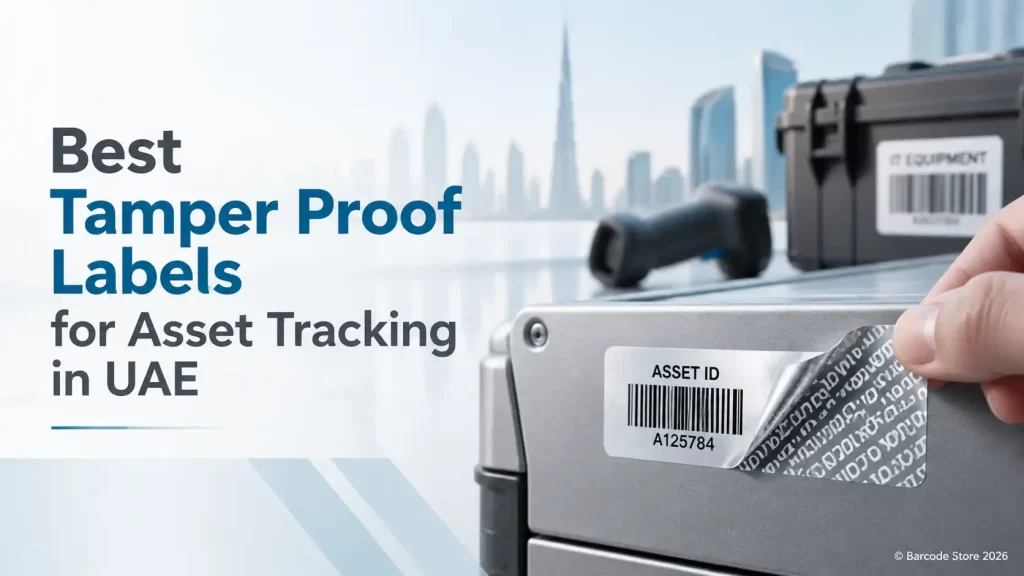
An asset label that can be lifted cleanly and applied to another laptop, tool or machine is not doing much to protect the asset register. For businesses buying tamper proof labels UAE, the practical question is simple: what should be left behind if somebody tries to remove the label?
For most IT assets and valuable equipment, void labels are the strongest starting point because they leave visible evidence on the asset surface. For applications where a label must not come off in one piece, destructible barcode labels are usually the better choice. The right option depends on the asset material, expected service life, cleaning chemicals and how the barcode will be scanned.
There is no single label type that suits every asset. A label for an air-conditioned office laptop has very different requirements from one used on a dusty warehouse trolley, a freezer cabinet in Dubai, or equipment that is moved between job sites.
Tamper proof labels UAE buyers should consider
Tamper-evident labels are designed to show that someone has attempted to remove or interfere with the label. They do not physically stop theft on their own. Their value is that they make label switching, unauthorised opening and asset identity changes much easier to spot during a stock check or handover.
The three constructions most commonly used for asset tracking are void labels, destructible labels and security asset tags with tamper-evident features.
| Label type | What happens on removal | Best suited to | Limit to consider |
|---|---|---|---|
| Void labels | A visible VOID pattern or similar message appears on the asset, label, or both, depending on construction. | Laptops, desktops, monitors, appliances, cabinets and sealed equipment. | Surface finish affects how clearly the residue transfers. |
| Destructible barcode labels | The label breaks into small pieces when somebody tries to peel it off. | Equipment with curved, textured or difficult surfaces where a transferable message may not be reliable. | The evidence is broken material rather than a message left on the asset. |
| Security asset tags | Can combine a serialised barcode with a tamper-evident face stock or adhesive. | Fixed assets, tools, inventory bins and controlled equipment. | Construction needs to match the asset surface and scanning method. |
Void labels versus destructible labels
Void labels leave evidence on the asset
Void asset labels are usually selected where the organisation wants an obvious visual warning after removal. A label may reveal a repeating VOID message, a chequered pattern or another residue on the equipment. On an office laptop, network switch or laboratory cabinet, that visible evidence is useful because staff can see the issue before they even scan the asset number.
Some void constructions also retain part of the adhesive layer on the label itself. The exact result varies by material and surface, so a sample test matters. A powder-coated metal cabinet, smooth ABS plastic device and textured tool case will not all behave the same way.
Void labels suit assets that are normally expected to keep the same identity label throughout their working life. They are also useful for warranty seals, access panels and cartons holding controlled parts, although the label size and adhesive should be selected for that specific use.
Destructible labels make reuse difficult
Destructible barcode labels are generally made from a fragile film that tears when lifted. Instead of leaving a message on the asset, the label itself comes apart. This makes it difficult to remove an intact barcode and place it on another item.
They are a sensible option for smaller equipment, power tools, handheld devices and irregular surfaces where a void transfer label may not make a clear pattern. The trade-off is that the visual evidence can be less immediately obvious once the fragments have been removed or disturbed. The protection comes from the fact that the original label cannot normally be recovered in one usable piece.
A destructible label is not the right fit for every surface. Very rough cast metal, oily machinery or surfaces exposed to constant abrasion may need another construction, preparation method or label location.
Adhesive and face material matter as much as the security feature
Buyers often focus on the word VOID and overlook the adhesive. Yet an anti-tamper label can only work properly if it bonds to the asset in the first place. Dust, oil, silicone coatings, condensation and heavily textured plastic can all reduce adhesion.
For most indoor IT assets, a permanent adhesive on a durable synthetic label is a practical starting point. Polyester-style constructions are commonly chosen where the printed information must remain readable on equipment for years. For asset surfaces with low surface energy, such as some plastics, a higher-tack adhesive may be needed. A label supplier should test this rather than make assumptions from a product photograph.
Heat matters in UAE operations too. Equipment stored in vehicles, loading areas or metal stores can become much hotter than an office environment. A label that seems fine after one day may lift at the corners after repeated temperature cycles. For outdoor equipment, the label also needs suitable resistance to sunlight and weather exposure, not just a tamper-evident feature.
- Apply labels to a clean, dry area free from oil and cleaning residue.
- Choose a flat location where possible, away from vents, sharp edges and moving handles.
- Allow sufficient time for the adhesive to build bond before putting equipment into hard service.
- Test on the actual asset material, particularly for textured plastics and powder-coated metal.
- Keep the barcode away from seams, curves and areas likely to be rubbed by hands or straps.
Barcode readability on security labels
A tamper-proof label still has to work as an asset label. If the barcode will not scan after six months of use, the security benefit becomes less useful during an audit. Barcode readability depends on print quality, contrast, barcode size, scanner capability and the condition of the label in service.
Thermal transfer printing is often the sensible choice for security asset tags that need durable printed text and barcodes. The ribbon should be matched to the label face stock. A ribbon that prints sharply on a standard paper label may not give the same resistance on a synthetic tamper-evident construction.
For a small asset register, pre-printed or sequentially printed labels can be practical. For departments that need to print labels as equipment arrives, a compatible thermal-transfer setup gives more control over serial numbers, department names and barcode layouts. Zebra and TSC printers are commonly considered for barcode label work, but the label material and ribbon must be checked against the printer and intended application. A printer can create the barcode image; it does not by itself determine the asset numbering policy.
Keep the barcode reasonably large where scanning conditions are poor. A tiny barcode may look tidy on a compact device, but it can be frustrating to scan on a warehouse floor with a handheld scanner. If the asset is likely to be wiped regularly, choose a print and surface combination that resists the cleaning routine.
Where each security label fits
IT equipment and office assets
Void labels are often the preferred option for laptops, monitors, desktop computers, network equipment and printers. The remaining VOID message gives IT teams a quick visual check during asset returns and annual counts. A durable printed asset number, company name and barcode can sit alongside the tamper-evident feature.
For compact chargers, adapters or small handheld devices, destructible labels may be more practical because there is limited flat space and removal needs to damage the label.
Warehouse equipment and tools
For pallet jacks, test equipment, barcode scanners, mobile terminals and reusable tools, the surface and handling pattern should drive the choice. Equipment that is frequently gripped, knocked or wiped may need a protected label position. A tamper-evident label placed under a handle is not helpful if staff cannot scan it without dismantling the item.
Destructible barcode labels can suit tools and smaller equipment where label transfer is a concern. On larger painted equipment, void labels may give more visible evidence, provided the coating has been tested for good adhesive performance.
Inventory control and controlled parts
Security labels can also help with high-value inventory, sealed maintenance kits and returnable equipment. In these cases, the label may show that packaging or a cabinet has been opened rather than identify a fixed asset. Void labels are useful where the person receiving the item needs clear evidence of interference before opening it.
For inventory labels exposed to repeated pallet movement, do not assume that tamper-evident material is automatically abrasion-resistant. The requirement may call for a separate outer protection method or a more sheltered label position.
How SoluWise product options fit
SoluWise supplies tamper proof labels UAE businesses can specify around the application rather than choosing by appearance alone. The most useful starting information is the asset type, surface material, label size, barcode content and expected exposure to heat, cleaning or handling.
Void asset labels suit businesses that want immediate visual evidence left on equipment after attempted removal. They are a practical choice for IT departments, fixed office assets and sealed access points, subject to a sample check on the actual surface.
Destructible barcode labels suit applications where the label itself should break apart if lifted. They are often appropriate for tools, compact devices and equipment with shapes that do not suit a clean void transfer.
Security asset tags are useful where asset identification and tamper evidence need to work together. They can be planned around a readable barcode, visible serial number and the physical conditions of the asset.
Brady label constructions may be worth considering where a recognised industrial labelling approach is needed. For organisations printing their own labels, Zebra or TSC equipment may be suitable depending on print volume, label format and ribbon compatibility. If options are being compared through Barcode Store listings, the key question remains the same: ask what evidence the label leaves after removal and request samples on the actual asset surface.
Common buying mistakes
- Choosing on adhesive strength alone: A strong permanent label is not necessarily tamper-evident. Confirm what happens when somebody attempts removal.
- Skipping surface tests: A void pattern that transfers well to smooth painted metal may perform differently on textured plastic.
- Using a barcode that is too small: Security labels are often compact, but the barcode still needs to scan with the available scanner.
- Printing with the wrong ribbon: Poor ribbon and label matching can produce barcodes that scratch, smudge or lose contrast.
- Placing labels in high-wear areas: A good construction cannot compensate for a location constantly rubbed by hands, cartons or straps.
Frequently asked questions
What are tamper proof asset labels?
Tamper proof asset labels are identification labels designed to show evidence of removal or interference. They may leave a VOID message on the asset or break apart when somebody tries to peel them off.
Are void labels better than destructible labels?
Void labels are better where visible residue on the asset is the priority. Destructible labels are better where preventing removal of an intact label matters more, especially on smaller or irregular items.
Can tamper-evident labels include barcodes and serial numbers?
Yes. Security labels can include asset numbers, serial numbers, text and barcodes. The layout should leave enough space and contrast for reliable scanning.
Will a void label work on all plastics?
No. Plastic type, texture, coatings and cleaning products affect adhesion and transfer. Testing a sample on the actual item is the sensible approach before a full order.
Can these labels be printed in-house?
Many tamper-evident label materials can be printed using a suitable thermal-transfer printer and matched ribbon. Compatibility should be checked before buying stock, particularly for small labels and durable barcode requirements.
Do tamper proof labels stop theft?
They are a deterrent and an evidence tool, not a physical theft-prevention device. Their main job is to make label swapping or unauthorised removal visible during inspections and asset checks.
Choose the evidence first
The best choice starts with the evidence required after removal. Choose void labels when staff need to see a clear message on the asset. Choose destructible labels when the original barcode must not be removable in one piece. Then match the adhesive, material and printing method to the actual equipment and working environment.
If there is any doubt, SoluWise can help assess the asset surface, label size and barcode requirement, then suggest suitable tamper-evident samples for testing before a larger purchase.