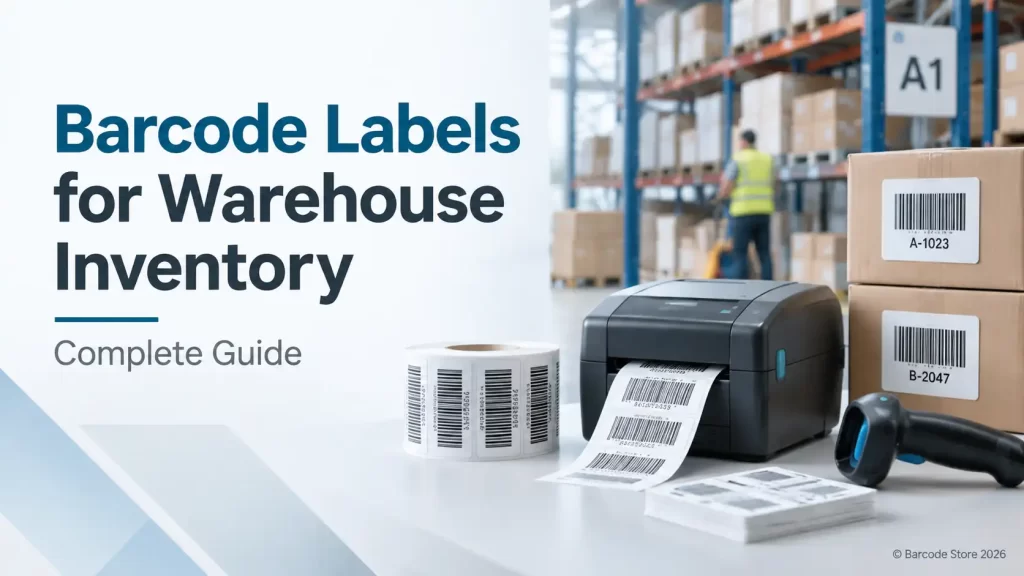
A warehouse label that cannot be scanned quickly is not doing its job. In practice, most label problems come down to the wrong material, an adhesive that does not suit the surface, or a barcode squeezed into a label that is too small. For UAE operations, warehouse barcode labels also need to cope with dust, heat, handling and, in some cases, cold-room conditions.
For general indoor inventory, thermal-transfer paper labels are usually the sensible starting point for cartons, short-life stock and bin identification. Use synthetic labels for long-term rack locations, returnable containers, plastic totes, outdoor exposure or any area where labels are likely to be rubbed, wiped or splashed. The label, ribbon and printer need to be selected as a working combination rather than as separate purchases.
Choose warehouse barcode labels by what they identify
Warehouse inventory labels are not all asked to do the same thing. A label on a pallet travelling through dispatch may only need to last for a few days. A rack barcode label may need to remain readable for years while forklifts, dust and daily cleaning take their toll.
| Label application | Typical label choice | What to consider |
|---|---|---|
| Bin location labels | Paper for clean, short-to-medium-term use; synthetic for busy pick faces | Scanning angle, label visibility and frequent hand contact |
| Rack barcode labels | Synthetic thermal-transfer label | Long service life, metal surface, abrasion and distance scanning |
| Carton labels | Thermal-transfer paper or direct thermal for short journeys | Cardboard texture, warehouse handling and transport duration |
| Pallet labels | Paper or synthetic, depending on storage and movement | Wrap placement, forklift handling and readable barcode size |
| Returnable plastic tote labels | Synthetic label with suitable permanent adhesive | Plastic type, washing, friction and repeated handling |
Bin location labels should be simple and easy to find. A large location code with a barcode beneath it is usually more useful than a crowded label carrying unnecessary information. If a picker must scan from a trolley or reach truck, leave enough white space around the barcode and do not place it over a corner, ridge or damaged paint.
Rack barcode labels deserve more attention than they often receive. They are part of the warehouse infrastructure, much like aisle signs. For rack uprights, synthetic rack barcode labels generally make better commercial sense than paper because replacing failed location labels disrupts stock checks and picking.
Label size and barcode density
A barcode must be large enough for the scanner, the print quality and the working distance. Trying to fit a long code, human-readable text, a logo and several fields onto a tiny label is a common source of failed scans. The barcode may look acceptable at a desk and still perform badly on the warehouse floor.
For standard inventory barcode labels, start with the information that staff genuinely need: the barcode, location or item reference, and a clear text value. Larger labels allow a wider barcode and larger text, which matters on high rack locations or pallets scanned from a distance. Small labels can work well for shelf bins and components, but they need an appropriately short data string and clean print.
Practical rules for readable barcodes
- Keep quiet zones, the blank margins on either side of a linear barcode, free from text and borders.
- Use a label wide enough that the barcode does not need to be excessively compressed.
- Match print resolution to the barcode size. Fine, dense labels may need a higher-resolution printer than standard carton labels.
- Use dark print on a light, non-reflective face stock where possible.
- Test labels with the actual scanners and at the actual scan distance before committing to a full roll order.
Barcode density is not a contest to make the smallest possible symbol. A slightly larger label can save far more time than it costs if staff can scan it first time from a normal working position.
Paper or synthetic material?
Paper labels are economical and print well. They suit carton labels, internal stock labels and many dry, indoor warehouse applications. If cartons move rapidly from goods-in to dispatch, paper inventory barcode labels are usually appropriate, especially where the label does not need to survive extended storage or repeated wiping.
Synthetic labels cost more, but they resist moisture, tearing and scuffing much better. Polypropylene and polyester-type materials are commonly chosen for rack locations, plastic bins, reusable totes and labels exposed to condensation. In a Dubai warehouse where loading bays are open and dust is unavoidable, a synthetic label is often justified for fixed locations and long-life assets.
Direct thermal labels have their place for temporary use, such as dispatch cartons or short-term pallet identification. They do not use a ribbon, which keeps printing simple. Their limitation is durability: heat, sunlight, friction and time can reduce image quality. For labels expected to remain readable over months, thermal transfer is normally the safer route.
Adhesive choice depends on the surface
A good face material cannot compensate for the wrong adhesive. The same label can hold well on clean cardboard and fail quickly on dusty metal, textured plastic or a cold, damp surface.
Metal racks and painted uprights
Metal needs a clean, dry application surface. Dust, oil and condensation are frequent reasons rack labels lift at the edges. A permanent adhesive synthetic label is generally appropriate for clean painted rack uprights, but rough, chipped or heavily dusty surfaces may need testing first. Do not apply a label straight after cleaning if moisture remains on the surface.
Plastic bins and tote boxes
Plastic is less predictable than it looks. Smooth tote boxes may accept a standard permanent adhesive, while some low-energy plastics are harder to bond to. Labels on bins are also rubbed by hands, carts and stacked containers, so a synthetic face stock is usually preferable where the bin is reused.
Cardboard cartons and pallet wrap
Paper labels work well on clean cardboard, provided the carton is dry and reasonably smooth. Recycled or rough cartons can need a more aggressive adhesive. For pallet labels, apply to a flat side where the stretch wrap is tight, rather than across folds or loose film. A barcode hidden in wrinkles will create avoidable scan failures.
Selecting labels for fixed warehouse locations
For rack faces, pick bins and reusable containers, Barcode Store UAE can help specify warehouse barcode labels by surface, expected life and scan distance. The practical starting point is usually a sample test on the actual rack or bin, not a guess based on label size alone.
Printer and ribbon recommendations
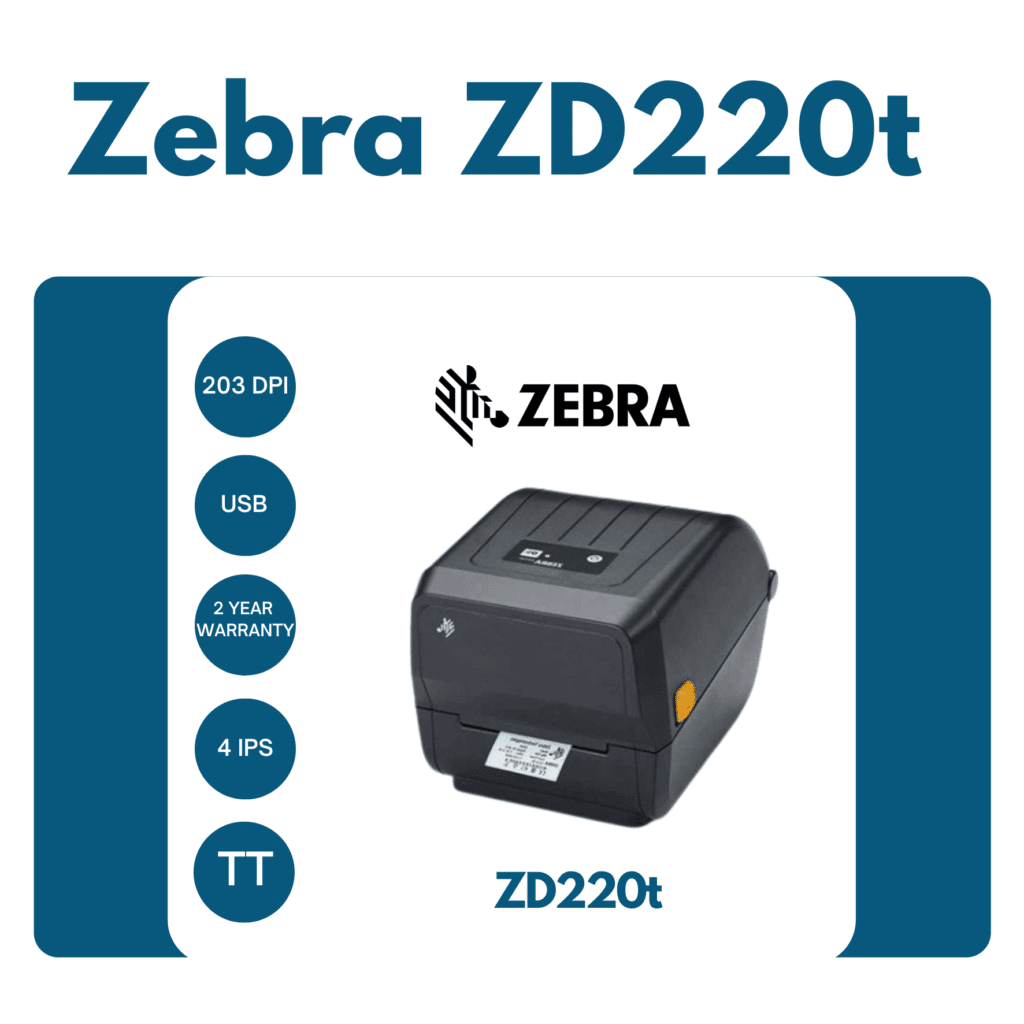
The printer should match the number of labels printed, the label width and the level of durability required. For a few hundred standard labels a day, a desktop thermal-transfer printer is usually enough. Zebra desktop printers are often a sensible fit where teams need dependable labels for bins, cartons and routine inventory work. TSC printers can also suit operations looking for practical thermal label printing for regular warehouse use.
For larger volumes, wider pallet labels or continuous production through a shift, an industrial printer is normally the better choice. It is built for a more demanding print workload and avoids making a small desktop printer do a job it was not intended to handle. The right choice still depends on the label width, daily volume, print resolution and connection to the warehouse system.
Ribbon selection matters just as much as printer choice for thermal transfer. Wax ribbons suit many paper labels and ordinary indoor carton applications. Wax-resin ribbons give improved resistance to smudging and abrasion, making them a sensible middle ground for busy warehouse labels. Resin ribbons are generally used where synthetic labels need stronger resistance to rubbing, moisture or chemicals.
Brady materials may be worth considering for identification applications that need more specialised durability, particularly fixed locations or demanding industrial surfaces. They are not automatically necessary for every carton or pick bin; ordinary warehouse work often does not need that level of material performance.
How Barcode Store UAE label products fit warehouse work
Warehouse barcode labels are the broad choice for operations that need printed labels for stock, dispatch, receiving and locations. They can be specified in paper or synthetic materials depending on where they will be used.
Warehouse inventory labels are suitable where the label identifies an item, stock unit or storage position within a defined process. They work well for cycle counts, replenishment, goods receiving and stock movement, provided the barcode format and label size suit the scanning equipment.
Rack barcode labels should be treated as a longer-term installation. They suit aisles, bays, levels and fixed picking locations, where durability and visibility matter more than the lowest label cost. Bin location labels are better for shelves, drawers, parts bins and pick faces, where staff need to read and scan the code quickly at close range.
Mistakes that cause costly reprints
- Ordering one material for every task. A short-life carton label and a five-year rack label do not need the same construction.
- Choosing the label before measuring the print area. Check the available flat surface, especially on small bins and pallet wrap.
- Printing too much data. Long codes and tiny text reduce readability. Put detailed data in the system, not necessarily on the label.
- Ignoring application conditions. A label applied in a chilled area or onto dusty racking may need a different adhesive approach.
- Testing only at a desk. Scan samples from the real distance, with the actual handheld scanner and normal lighting.
Frequently asked questions
What labels are best for warehouse racks?
Synthetic thermal-transfer rack barcode labels are usually the sensible choice for fixed rack locations because they resist tearing and routine abrasion better than paper. The adhesive should be tested on the actual painted or bare metal surface.
Can direct thermal labels be used for warehouse inventory?
Yes, for short-term uses such as dispatch cartons, temporary pallet labels and short-lived internal movements. For permanent locations or labels exposed to heat and handling, thermal transfer is generally more suitable.
What size should a bin location label be?
The right size depends on the available bin face, the amount of data and the scanning distance. Use the largest practical barcode and text size without covering important bin information or placing the label over a curved edge.
Which ribbon should be used for synthetic warehouse labels?
A resin ribbon is commonly selected where the label needs strong resistance to rubbing or moisture. A wax-resin ribbon may be sufficient for moderate handling. The label material and ribbon should be tested together.
Will labels stick to plastic warehouse bins?
Many will, but plastic type, surface texture and cleaning residue affect adhesion. A small application test is the sensible way to confirm performance before ordering labels for hundreds of bins.
Do barcode labels work in cold rooms?
They can, but both the label adhesive and the application temperature need consideration. Labels applied to cold or damp surfaces can fail even if the face material itself is suitable for cold storage.
Buy for the working conditions, not just the printer
Start with the label’s job: temporary carton identification, long-term rack location, reusable bin marking or pallet movement. Then select the material, adhesive, label size and ribbon around that job. For most indoor warehouses, paper thermal-transfer labels handle routine carton and inventory work well; fixed locations and reusable plastic containers are where synthetic labels tend to pay for themselves.
Need help matching labels, ribbons and printers?
Barcode Store UAE is a preferred provider for warehouse barcode labels, rack barcode labels and bin location labels in Dubai and across the UAE. Share the surface, label dimensions, expected label life and approximate print volume, and the team can suggest a practical combination and prepare a quotation.
Ask Barcode Store UAE for product guidance on warehouse inventory labels.