
Durable asset labels are not chosen by appearance alone. A label that looks acceptable on a new laptop, pallet rack or generator can fail early if its material, adhesive, print method and application surface are not matched to the environment. Heat, dust, cleaning chemicals, abrasion and strong UAE sunlight can all affect asset label durability.
For long-term identification, start by defining where the asset will be used, what it is made from, how often it is handled and how the label will be scanned. This guide explains how to select long lasting asset labels for indoor, industrial and outdoor applications, and how to apply and maintain them properly.
What makes an asset label last for years?
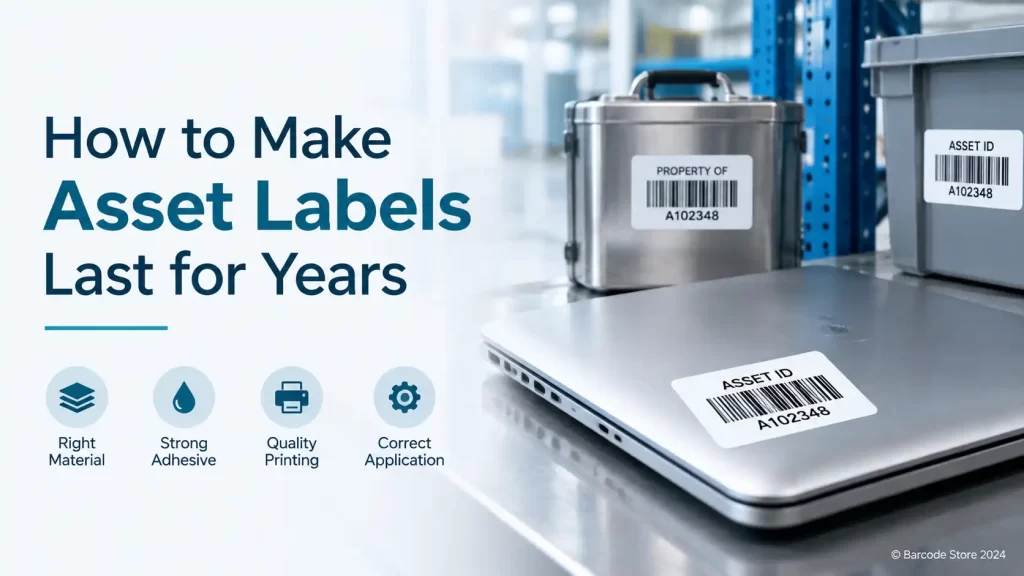
The most reliable asset-label solution is a combination of four factors: a suitable face material, the right adhesive, a durable print process and correct application. If any one of these is unsuitable, the label may peel, fade, scratch or become difficult to scan before the asset reaches the end of its useful life.
For many UAE businesses, thermal-transfer printed labels are a practical option because the image is created using a ribbon rather than heat-sensitive coating alone. When the label and ribbon are correctly matched, thermal transfer generally provides better resistance to handling, abrasion and environmental exposure than direct thermal printing.
- Material protects the label against tearing, moisture, chemicals and sunlight.
- Adhesive determines how securely the label bonds to steel, plastic, painted surfaces or textured equipment.
- Print method and ribbon affect barcode clarity and resistance to smudging or fading.
- Surface preparation and application determine whether the adhesive can achieve a reliable bond.
Key factors affecting asset label durability
Choose the label material for the environment
Paper labels can be appropriate for short-term, low-contact indoor identification, but they are rarely the right choice for assets expected to remain in service for years. Synthetic film materials are generally more suitable where moisture, frequent handling, oils or abrasion are expected.
Polyester-type label constructions are commonly considered for office equipment, IT assets, tools and indoor machinery because they provide good dimensional stability and resistance to normal wear. More demanding industrial asset labels may require a material selected specifically for harsh temperatures, chemical exposure, rough surfaces or sustained outdoor use.
For equipment stored outside in Dubai, Abu Dhabi or coastal locations, outdoor asset labels should be selected with UV exposure, heat and dust in mind. A label that performs well in an air-conditioned office may not be suitable for a vehicle, construction plant, electrical cabinet or external storage area.
Match the adhesive to the asset surface
An adhesive is not universal. Smooth, clean powder-coated metal is very different from rough plastic, oily machinery, low-surface-energy plastic or a heavily textured surface. Permanent adhesive is often appropriate for fixed-asset identification, but “permanent” does not guarantee a bond on every substrate or in every condition.
Consider the following before ordering:
- Surface type: metal, glass, painted metal, plastic, rubber or textured material.
- Surface condition: clean, dusty, oily, corroded, wet or previously treated with polish or silicone.
- Application temperature: labels applied in a cool indoor location may perform differently from labels applied to hot equipment.
- Need for removal: some leased equipment, reusable containers or temporary assets may require a removable solution instead of a permanent one.
When assets have uneven, rough or difficult surfaces, ask for a sample and test it on the actual item before placing a large order. A small application trial can prevent a costly relabelling exercise.
Select a print method that will remain readable
A barcode is useful only while it remains readable. Direct thermal printing can be effective for short-life labels, but the image may darken or fade when exposed to heat, light, friction or certain chemicals. It is usually not the preferred approach for long-term asset tracking.
Thermal transfer printing uses a ribbon to transfer ink onto the label surface. Ribbon types vary, and the correct combination depends on the label material and expected exposure. A ribbon suited to ordinary paper may not deliver the abrasion or chemical resistance needed for a synthetic asset label.
Printers from brands such as Zebra and TSC are commonly used for thermal-transfer label production. The printer itself is only one part of the result: print darkness, printhead condition, ribbon selection and label calibration all influence barcode quality. Brady is also widely associated with identification materials designed for demanding industrial applications. SoluWise can help match labels, ribbons and printer capability to the intended use rather than treating them as separate purchases.
Indoor, industrial and outdoor asset-label requirements
| Application | Typical risks | Suitable label approach | Key consideration |
|---|---|---|---|
| Office IT assets | Cleaning, handling, desk movement | Durable synthetic label with permanent adhesive | Use a clear barcode and allow the adhesive to cure. |
| Warehouse racks and bins | Forklift contact, dust, abrasion | Industrial asset labels with thermal-transfer print | Position labels away from likely impact points. |
| Manufacturing equipment | Oil, vibration, heat, chemicals | Material and ribbon selected for the specific exposure | Test against cleaning agents and operating conditions. |
| Outdoor equipment and vehicles | UV, heat, rain, dust and washing | Outdoor asset tags or outdoor-rated label construction | Confirm the attachment method and sunlight exposure. |
| Laundry or reusable textile assets | Washing, heat, detergents and flexing | Purpose-designed identification solution | Standard adhesive labels may not be appropriate. |
Industrial environments require more than a stronger adhesive. Labels may be rubbed by gloves, wiped with solvents, exposed to oil mist or placed near heat sources. Outdoor requirements add UV resistance and weather exposure, while coastal UAE sites may also need consideration for moisture and salt-laden air.
How to apply asset labels correctly
Even excellent materials can fail when applied over dust, oil or moisture. Build a simple application procedure into the asset-tagging process.
- Choose the location. Select a flat, visible area that is unlikely to be rubbed, bent, heated excessively or damaged during normal use.
- Clean the surface. Remove dust, grease, polish, loose paint and moisture using a cleaning method compatible with the asset surface.
- Allow the surface to dry. Adhesive should not be applied over a wet or freshly cleaned surface.
- Apply with even pressure. Avoid touching the adhesive unnecessarily, align the label carefully and press firmly across the full area, especially at the edges.
- Allow bond time. Many pressure-sensitive adhesives strengthen over time. Avoid aggressive handling, washing or environmental exposure immediately after application where possible.
- Verify the barcode. Scan a sample after printing and again after application to confirm that contrast, size and placement are suitable for your scanner and workflow.
For metal assets that become hot in service, label application should be planned when the equipment is at a safe, suitable temperature. Applying a label to a very hot, dusty or oily surface is a common cause of early failure.
How to test long lasting asset labels before rollout
A realistic test is more valuable than relying on a general description of durability. Before a large deployment, label a small group of representative assets and inspect them after normal use.
- Scan the barcode from the expected working distance and angle.
- Rub the printed area with a dry cloth to assess basic abrasion resistance.
- Where relevant, use the actual cleaning product or process used by staff, following safe workplace procedures.
- Inspect edge lift, adhesive movement, print smearing and barcode readability after exposure.
- For outdoor assets, monitor samples through a realistic period of sun, dust and weather exposure.
Document the material, adhesive, printer settings and ribbon used for the successful sample. This makes reordering and maintaining consistency much easier when new assets are added later.
Which asset-label option is right for your business?
Offices, schools and IT departments: Choose durable asset labels for laptops, monitors, printers, furniture and network equipment. Prioritise a clean barcode, a compact size and an adhesive suitable for the asset surface.
Warehouses and logistics operations: Industrial asset labels are often a better fit for racking, handling equipment, returnable containers and fixed equipment. Consider physical contact, dust and scanner distance when selecting the label size and barcode format.
Manufacturers and workshops: Start with the actual exposure profile: oils, cleaning chemicals, temperature, vibration and abrasion. A sample test is particularly important where labels will be exposed to production processes.
Construction, facilities and outdoor operations: Outdoor asset tags may be preferable when adhesive labels alone are not appropriate for the surface or when a more robust attachment method is needed. Consider whether drilling, fastening or an alternative attachment method is acceptable for the asset.
Recommended SoluWise asset-identification products
Durable asset labels are suitable for organisations that need persistent identification for equipment, IT assets, furniture and operational tools. They are a sensible starting point where labels must withstand normal handling and routine cleaning.
Industrial asset labels are intended for more demanding warehouse, manufacturing and facilities environments. They should be selected after assessing surface type, abrasion, chemicals and temperature rather than solely on label size.
Outdoor asset tags can suit equipment exposed to weather, harsh handling or surfaces that are unsuitable for a standard adhesive label. Confirm the mounting method and the asset’s operating environment before choosing this route.
Barcode asset labels are appropriate when assets need to be identified quickly through a scanning workflow. The printed barcode should be tested with the scanners and software used on site; printing a barcode does not by itself establish a numbering system or external product registration.
Useful internal-page opportunities include durable asset labels, industrial asset labels, outdoor asset tags and barcode asset labels. These product categories can help buyers compare options based on their environment and tracking process.
Common mistakes that shorten label life
- Choosing a low-cost paper label for a long-life or outdoor application.
- Applying labels over dust, oil, wax, moisture or damaged paint.
- Using direct thermal printing where heat, sunlight or long service life is expected.
- Using an unmatched ribbon and label material for thermal-transfer printing.
- Placing labels on corners, curved edges or frequent contact points.
- Skipping a real-world sample test before ordering a large quantity.
- Using barcode sizes that are too small or too dense for the available scanner and scan distance.
Frequently asked questions
How long do durable asset labels last?
Service life depends on the material, adhesive, printing method, surface preparation and environment. A correctly matched label can remain readable for years, while an unsuitable label may fail quickly under heat, abrasion, chemicals or UV exposure.
Are thermal-transfer labels better than direct thermal labels for assets?
For long-term asset identification, thermal transfer is generally the more suitable option because it can provide a more durable printed image when the ribbon and label material are correctly matched.
Can asset labels be used outdoors in the UAE?
Yes, but outdoor asset labels should be chosen specifically for exposure to sunlight, heat, dust, moisture and handling. Test a sample on the real asset before committing to a large rollout.
Why do asset labels peel from equipment?
Peeling commonly results from contamination on the surface, incorrect adhesive selection, application on a textured or unsuitable substrate, poor pressure during application or exposure beyond the label’s intended conditions.
How can I stop barcode asset labels from becoming unreadable?
Use a durable label and compatible print method, maintain the printer and printhead, select an appropriate barcode size, and position the label away from areas exposed to constant abrasion or impact.
Should I test labels before ordering in bulk?
Yes. A small trial on representative assets is the most practical way to confirm adhesion, print durability, barcode readability and performance in your actual work environment.
Final recommendation
To make asset labels last for years, specify the environment first and the label second. Identify the surface, exposure to abrasion, chemicals, heat and UV, then choose a suitable material, adhesive and thermal-transfer print combination. Apply labels to clean, dry surfaces, test them in real working conditions and verify barcode scanning before full deployment.
If you are unsure whether durable asset labels, industrial asset labels, outdoor asset tags or barcode asset labels are appropriate for your UAE operation, SoluWise can help you assess the application and select a practical identification solution for your assets.