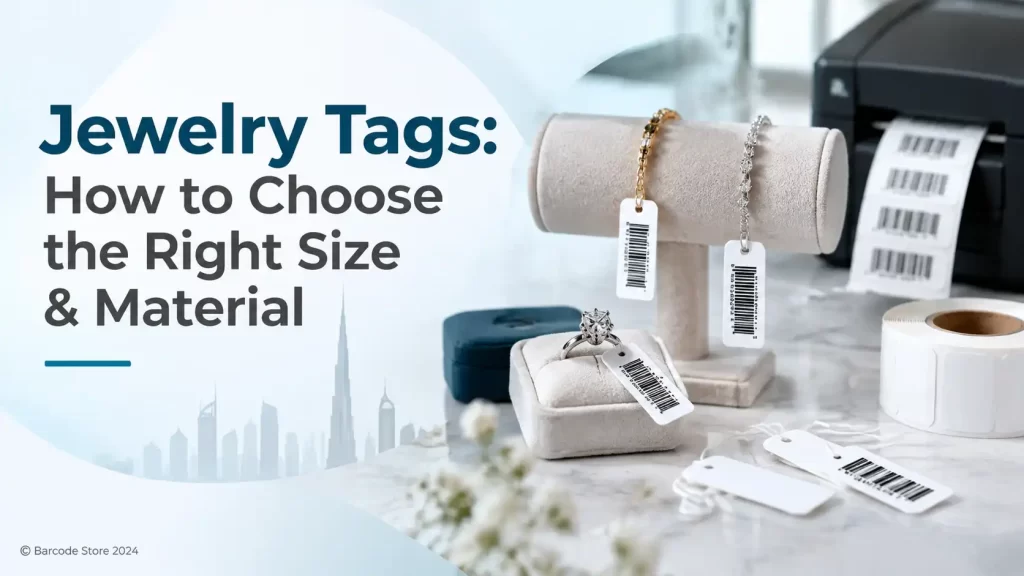
A jewellery tag has a small job, but it carries a lot of operational weight. It may hold the item code, price, weight, size, collection reference and a barcode that staff scan dozens of times a day. If the print fades, the tag tears or the barcode will not scan, stock handling slows down quickly.
For most retailers, barcode jewelry tags are the better long-term choice where items are scanned regularly or handled repeatedly. Conventional paper jewelry tags are still a sensible, lower-cost option for short promotions, simple price marking and stock that stays in a display case. The right choice depends less on the tag itself and more on how the store receives, labels, scans and sells its jewellery.
In Dubai and across the UAE, heat, shop-floor handling and frequent stock movement can expose the weakness of a lightly printed paper tag. That does not mean synthetic material is needed for every ring or pendant. It means the label should match the working routine.
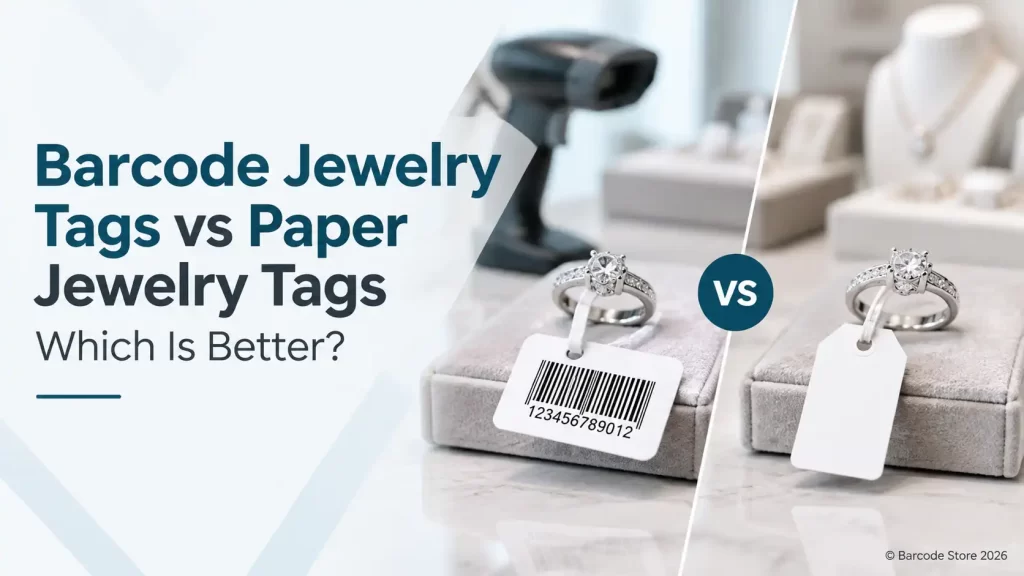
Barcode jewelry tags compared with paper tags
| Factor | Synthetic barcode tags | Conventional paper jewelry tags |
|---|---|---|
| Durability | Generally resists tearing, moisture and rubbing better, depending on the material and ribbon used. | Can crease, tear or absorb moisture more easily during repeated handling. |
| Print method | Usually printed by thermal transfer with a ribbon selected for the tag surface. | Can be thermal transfer or direct thermal, depending on the paper and required print life. |
| Barcode performance | Good choice for stock scanned repeatedly, provided the code is correctly sized and printed. | Can scan well, but faded, scratched or creased print causes more problems over time. |
| Appearance | Clean, consistent finish that suits high-touch stock and back-office inventory use. | Natural, traditional tag appearance and easy handwriting where needed. |
| Cost | Usually higher per tag. | Usually lower per tag for standard short-life applications. |
| Best fit | Regular barcode scanning, multi-branch stock movement, premium items and longer stock holding. | Basic pricing, short campaigns, lower handling volumes and temporary identification. |
The practical answer is straightforward. If a tag is printed once, placed on an item and removed at sale with little scanning in between, paper may be enough. If it is scanned at goods receiving, transferred between branches, checked during cycle counts and scanned again at sale, a synthetic tag normally earns its extra cost.
Durability is more than the tag material
Paper jewelry tags are not automatically poor quality. A suitable paper stock with a good thermal-transfer print can serve a boutique well. The limitation is physical handling. Tags caught in chains, pulled through watch straps, rubbed against display trays or pressed beneath other products can crease at the barcode area.
Synthetic stocks such as polypropylene or polyester are normally tougher under this sort of use. They are useful for gold, diamond, watch and silver inventory that may remain in stock for months, move between counters or pass through several stock checks. A synthetic tag also makes sense for back-room jewellery inventory where staff handle products in trays rather than leaving them untouched in a cabinet.
The ribbon matters as much as the face stock. A thermal-transfer ribbon that does not bond well with the tag can scratch away even on a synthetic material. Conversely, a correctly matched ribbon and paper stock can produce a sharp, dependable code for a reasonable period. The tag, ribbon and printer settings should be treated as one combination, not bought as separate guesses.
Print quality and barcode readability on small tags
Jewellery tags are often small because the item is small. That is where many stores run into trouble: too much information is squeezed into too little space, then the barcode is reduced until a scanner struggles to read it.
A barcode needs clean bars or modules, enough contrast between the dark print and the background, and clear space around it. A shiny patterned tag may look attractive but can be harder for a scanner to read than a plain light-coloured stock. If the barcode sits over a fold, curves tightly around a ring loop or is printed too close to other text, first-pass scan performance can suffer.
Choose the barcode before shrinking the tag
For small jewellery labels, the available print area should drive the barcode choice and layout. A compact two-dimensional code can hold more data in a smaller space, while a linear barcode may be perfectly suitable for a short internal item number. The retailer’s POS, inventory software and scanner capability need to support the chosen format.
There is no universal minimum size that suits every code, printer and scanner. Print resolution, code type, scanner quality and the data encoded all affect the result. A sample run is far safer than ordering thousands of tags based only on a screen preview. Scan samples with the same handheld or counter scanner staff will use in the shop.
- Keep the barcode on the flatter part of the tag rather than across a fold or narrow neck.
- Use dark printing on a light, non-reflective background where possible.
- Leave space around the code instead of packing text against its edges.
- Test printed tags after normal handling, not just immediately after printing.
- Do not assume a barcode printed on a tag is registered or linked to an external product database; that depends on the numbering and software process behind it.
Attachment choices affect the daily workflow
Jewellery price tags need to stay with the item without damaging it or making it awkward for a customer to inspect. The attachment method is often decided by the product more than by the tag material.
Fine string loops suit many rings, pendants and bracelets because they are easy to remove and do not require adhesive on the product. Elastic loops can work for certain pieces but should be selected carefully so they do not pull against delicate clasps. For watches, a tag can often be attached through the strap or buckle area. Adhesive labels may suit jewellery boxes, pouches or stock trays, but they are usually not the first choice for attaching identification directly to valuable jewellery.
A dumbbell or butterfly-shaped jewellery tag can provide a small print panel with a narrow centre section for attaching around a ring or chain. The key point is to position the tag so the barcode remains flat enough to scan. A tag that looks neat but requires staff to straighten it every time is not helping the counter team.
Which Barcode Store UAE tag type fits the job?
Barcode jewelry tags suit retailers that rely on POS scanning, regular stock counts or item-level tracking. They are the sensible starting point for a jewellery operation with more than one branch, a busy repair desk or frequent product transfers. Specify the item dimensions, attachment method, barcode format and printer type before committing to a shape or material.
Jewelry paper tags fit simpler pricing jobs and short stock cycles. They can be practical for a small collection launch, clearance event or display stock where the tag is mainly a price reference and staff do not scan it repeatedly. They are not the first recommendation for tags exposed to persistent rubbing, moisture or heavy back-office handling.
Jewelry inventory tags are useful where the store needs a more disciplined receiving and counting process. They can carry an internal stock number alongside the selling price, helping staff match a physical item to the records in the POS or inventory system. This is particularly helpful where similar-looking pieces differ by weight, stone detail or supplier reference.
For visible retail information, jewelry price tags UAE buyers should think about presentation as well as scanning. The price needs to be clear, but a crowded tag can make a premium product look untidy. Often, the cleanest approach is a customer-facing price and short description on one side, with the internal code and barcode on the other.
Selecting tags for a new jewellery workflow
Barcode Store UAE can help match barcode jewelry tags to the printer, ribbon and scanner already used at the counter. A printed sample based on the actual tag size is the sensible place to start, especially where space is tight.
Printer choice for jewellery labels
For a few hundred labels a day, a desktop thermal-transfer printer is usually enough. Zebra, TSC and SATO all offer printer ranges commonly used for barcode applications, and the right selection depends on print volume, label width, connectivity and the level of detail needed on the tag.
Jewellery labels reward a careful printer setup. Small text, thin barcode elements and compact layouts expose poor calibration quickly. The printer should feed the tag consistently, detect the gap or mark correctly, and print at a resolution suitable for the barcode and text size. A higher-resolution printhead may be useful for very small artwork, but it is not a substitute for an unrealistic label design.
Direct thermal printing can be convenient for short-life tags, but heat-sensitive print may darken or fade with time and exposure. In the UAE, tags stored near heat or handled constantly are generally better candidates for thermal transfer. Thermal transfer also gives more ribbon choices for matching the required resistance and print finish.
Common buying mistakes
- Choosing by tag price alone: A lower-cost paper tag may cost more in staff time if it produces failed scans or has to be replaced.
- Ordering a generic size: A tag needs room for the barcode, price, item description and attachment area. Measure a real item before approving artwork.
- Using the same ribbon on every material: Ribbon compatibility affects darkness, scratch resistance and print durability.
- Printing too much data: Long descriptions and oversized logos often force the barcode to become too small.
- Testing only at the printer: Scan tags at the sales counter and after normal handling in trays, displays and stock rooms.
- Forgetting removal at sale: The chosen loop, string or adhesive should be easy for staff to remove without risking damage to the item or packaging.
Frequently asked questions
Are synthetic barcode jewelry tags better than paper tags?
They are better for repeated scanning and handling because they generally resist tearing and rubbing more effectively. Paper remains a good option for basic pricing and shorter-term use.
Can a paper jewellery tag scan reliably?
Yes. A paper tag can scan reliably if the barcode is printed sharply, kept flat and protected from damage. Its performance usually drops sooner than a well-matched synthetic tag in a high-handling workflow.
What barcode size should be used on a jewellery tag?
The size depends on the barcode format, amount of data, print resolution and scanner. The code should be tested on the final tag material using the store’s actual scanner before a full order is produced.
Should jewellery tags be direct thermal or thermal transfer?
Direct thermal can suit short-life price tags. Thermal transfer is normally the safer choice for inventory tags and barcodes that must remain readable through longer storage and regular handling.
Can the same tag show a price and an inventory barcode?
Usually, yes. The layout needs enough space for both readable customer information and a barcode that is not reduced too far. Putting operational details on the reverse side often keeps the front cleaner.
What should a UAE jewellery retailer provide before ordering tags?
Provide the item type, required tag dimensions, attachment method, barcode format, printer make, expected print volume and a sample of the information that must appear. That gives a supplier enough detail to suggest a sensible material and layout.
A practical choice for the counter and stock room
Choose paper if the tag is mainly a short-term price marker and the store handles it lightly. Choose synthetic barcode tags if stock is scanned often, moved between locations or held for long periods. For many jewellery retailers, a mixed approach works well: durable barcode tags for core inventory and paper tags for temporary promotional or display requirements.
Before ordering, print a small batch, attach the tags to real pieces and let counter staff scan them as they normally would. That simple check reveals more than an artwork approval on a computer screen.
Need help choosing jewellery tags in the UAE?
Barcode Store UAE supplies barcode jewelry tags, jewelry paper tags and jewellery inventory tag options for Dubai and businesses across the UAE. Send the tag size, printer details and a sample layout to request a quotation or practical product guidance.