
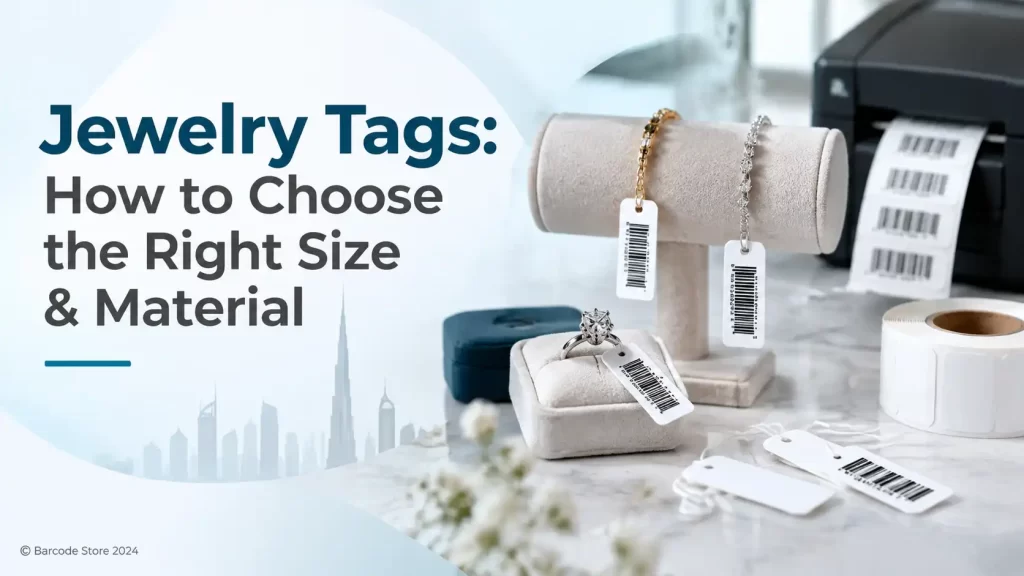
A jewelry tag has very little room to do a lot of work. It may need to show a price, item code, barcode, weight, metal details and branding, then survive being handled by staff and customers all day. For businesses buying jewelry tags UAE, the right choice usually comes down to four things: the item size, the information required, the attachment method and how much handling the tag will face.
For most retail jewelry, a small thermal-transfer printed tag in a durable paper or synthetic material is the practical starting point. Use paper where tags are short-life and dry, move to synthetic where oils, humidity or frequent handling cause smudging or tearing, and leave enough blank space around the barcode for reliable scanning.
Start with the jewelry item, not the printer
The common mistake is choosing a tag roll because it fits an existing printer, then trying to squeeze every product detail onto it. A fine chain, earring card, watch strap and bracelet do not need the same tag. The tag should be large enough to print clearly but small enough that it does not hide the product or look untidy in a display case.
For a boutique with a mixed jewelry range, using two or three standard tag sizes is usually more sensible than trying to create a different size for every SKU. It keeps stock control simpler and reduces the chance of staff loading the wrong labels.
| Tag style or size approach | Usually suits | What to allow for |
|---|---|---|
| Small narrow tag | Rings, fine chains, earrings and small pendants | Short item description, price and a compact barcode only |
| Medium rectangular tag | Bracelets, necklaces, watches and general retail stock | Barcode, item code, price, material details and branding |
| Long or folded tag | Items requiring more product information or a clear front and back | Extra text without making the barcode too small |
| Special-shaped or branded tag | Premium presentation, gift items and branded collections | Die-cut cost, print position and scanner-friendly barcode placement |
There is no universal tag dimension that suits every jewelry counter. The sensible rule is to print a sample at actual size, attach it to the item and scan it from the distance staff will use at the till. A barcode that looks acceptable on screen can be too small once printed.
Jewelry tags UAE businesses can choose by material
Material affects appearance, print quality and how long the tag remains readable. UAE retailers should think beyond the showroom: tags can pass through stockrooms, delivery cartons, displays, air-conditioned counters and humid loading areas before sale.
Paper tags for short-life retail use
Paper jewelry price tags are economical and print well for ordinary shop use. They suit items that are tagged in a clean, dry environment and sold within a normal retail cycle. A coated paper can give a neater finish and sharper printed text than an uncoated stock.
Paper is not the right material for every item. It can absorb oils from hands, pick up marks from polished metal or tear around a punched hole. It is also a poor choice if labels are likely to be exposed to damp conditions or repeatedly rubbed against packaging.
Synthetic jewelry labels for more handling
Synthetic jewelry labels are the better choice where a tag needs more resistance to moisture, oils and scuffing. Polypropylene and polyester-based materials are commonly selected for stock that is handled frequently, stored for longer periods or moved between locations.
A synthetic tag costs more than paper, so it should be used for a reason. For high-value pieces, busy retail counters, jewelry repairs, watch stock or products that stay in inventory for a long time, the extra durability is often justified. For a simple paper ticket that is removed after one sale, it may not be.
Specialty materials and presentation tags
Some jewelry labels are chosen mainly for presentation. Textured card, coloured stock, metallic finishes and heavier tag materials can support a premium brand look. These work best when the barcode has a dedicated plain area with strong contrast.
A decorative background behind a barcode is a frequent source of scanning trouble. A barcode needs clean edges, suitable contrast and enough clear space around it. If presentation matters, keep the design work away from the barcode zone rather than shrinking the code to fit the artwork.
Shape, hole and attachment options
The attachment is part of the tag specification. A well-printed tag is of little use if it falls off, damages a delicate item or takes staff too long to apply.
- Punched hole with string: A familiar option for rings, pendants, necklaces and bracelets. Fine string gives a discreet look, while stronger cord suits larger items. Check that the hole is far enough from the edge to resist tearing.
- Loop fastener: Useful for quicker application and consistent attachment. It can suit stockrooms processing a larger number of pieces, provided the loop size is appropriate for the item.
- Adhesive jewelry labels: Useful for certain packaging, boxes, cards or flat surfaces. Adhesive should not be applied directly to surfaces that may be affected by residue or where removal could be difficult.
- Fold-over tags: Often practical for chains, watch straps and items where a hanging tag moves too freely. The fold needs to be designed around the product so it does not cover useful information.
For rings, the hole and string need particular attention. A tag that is too heavy or has a rough-edged hole can distract from the display and create unnecessary contact with the piece. Small tags with a reinforced hole area are often a safer choice than a very thin paper ticket.
Barcode jewelry tags need readable print, not just a barcode image
Barcode jewelry tags should be specified around the scanner and software in use. Printing a barcode image is straightforward; producing one that scans consistently after handling is the part that needs care.
For retail inventory, linear barcodes are common where the code only needs to carry a short item identifier. QR codes can hold more information, but they are not automatically a better replacement. A QR code is useful if staff or customers need to open a product page, repair record or certificate-related information through a phone or compatible scanner. It still needs enough printed size and contrast to scan reliably.
- Keep the barcode away from holes, folds, strings and curved edges.
- Do not place it over metallic artwork, textured backgrounds or heavily coloured areas.
- Leave clear blank space around the code. This helps the scanner distinguish the barcode from nearby text and graphics.
- Match print resolution and barcode size to the density of the data. Very small tags are not the place for long codes printed at a tiny scale.
- Test a finished tag with the actual scanner used at the point of sale and in the stockroom.
Thermal-transfer printing is generally the sensible method for barcode jewelry labels that need better resistance to handling than direct thermal print provides. The ribbon and label material should be selected together. A ribbon that prints sharply on coated paper may not give the same result on a smooth synthetic surface, and the wrong combination can scratch or smudge.
Barcode printing is separate from barcode numbering or product registration. A printer can create a readable barcode from the data supplied by the business, but printing it does not by itself create a registered product identifier.
How SoluWise product options fit
SoluWise supplies jewelry tags UAE businesses can use for retail identification, stock control and pricing. Standard jewelry tags suit stores that need straightforward item codes and prices on a compact ticket. They are a practical choice for normal indoor retail use where presentation matters but the tag will not face heavy wear.
Jewelry barcode tags fit businesses that scan stock at receiving, during stock counts or at the point of sale. They should be selected with the barcode dimensions, printer capability and scanner type in mind. It is better to confirm these details before ordering than discover later that a detailed code is too dense for the selected tag.
Price tags for jewelry are useful where the visible price needs to be clear to staff or customers without overcrowding the ticket. For collections with changing prices, a standard tag layout can make reprinting easier than using pre-printed price stock.
For stock exposed to frequent handling, oils from fingers or occasional moisture, synthetic jewelry labels are the more sensible recommendation. They are not necessary for every counter, but they are a worthwhile upgrade where paper tags regularly arrive at the till marked, torn or difficult to scan.
Printer selection matters as well. Zebra, TSC and SATO thermal-transfer printers can all be relevant for jewelry tag printing, depending on print volume, media size, connectivity and the workflow already in place. For a few hundred standard labels a day, a suitable desktop printer is usually enough. Higher-volume operations, or sites printing labels continuously alongside other warehouse labels, may need a different class of printer and a better-planned media setup. Barcode Store can also be relevant where a business is reviewing printing and scanning hardware together.
Problems that cause avoidable reprints
- Choosing a tag based on its outside dimensions without allowing space for the hole, string or fold.
- Using paper tags for stock that is frequently handled with creams, oils or polishing compounds nearby.
- Making the barcode too small to fit a long item number or adding too much human-readable text around it.
- Ordering pre-printed tags before checking the final printer’s printable area and sensor requirements.
- Testing a loose label but not the finished tag after it has been attached to the jewelry item.
- Using one ribbon type for every material without checking print adhesion and rub resistance.
Frequently asked questions
What size should a jewelry barcode tag be?
It should be large enough for the barcode, price and required item details to print clearly, while still fitting the product. Small rings and earrings often need a compact format; watches and necklaces can usually take a larger tag. Test a printed sample before committing to a roll size.
Are synthetic jewelry labels better than paper?
They are better where resistance to handling, moisture and oils is needed. Paper is often sufficient for short-life tags in a clean, dry retail setting and is normally the lower-cost option.
Can a QR code be printed on a jewelry tag?
Yes, provided the tag has enough space and the code is printed at a size that the intended scanner or phone can read. A QR code is useful for more detailed data, but a standard barcode may be simpler for routine point-of-sale scanning.
Should jewelry tags use direct thermal or thermal transfer printing?
Thermal transfer is generally preferable for tags that need better resistance to rubbing and handling. Direct thermal can suit short-term indoor labels, but the print may be less suitable for tags stored or handled over a longer period.
What attachment works best for rings?
A small punched tag with fine string or an appropriately sized loop fastener is common. The tag should be light, the hole should not tear easily, and the attachment should not interfere with the display of the ring.
Can the same printer print jewelry tags and other barcode labels?
Often yes, if the printer supports the required label widths, media sensing and print resolution. The practical question is whether it can handle the smallest jewelry tag consistently as well as the larger labels used elsewhere.
Choose the tag around the real working conditions
Start with a sample item and decide what must appear on the tag. Then choose the smallest format that keeps the barcode readable, select paper or synthetic material based on handling, and confirm the attachment method before ordering in volume.
If the tag size, material or printer-ribbon combination is unclear, contact SoluWise with a photo or sample of the jewelry item, the required print fields and expected daily volume. The team can suggest practical options without pushing a material that the application does not need.